
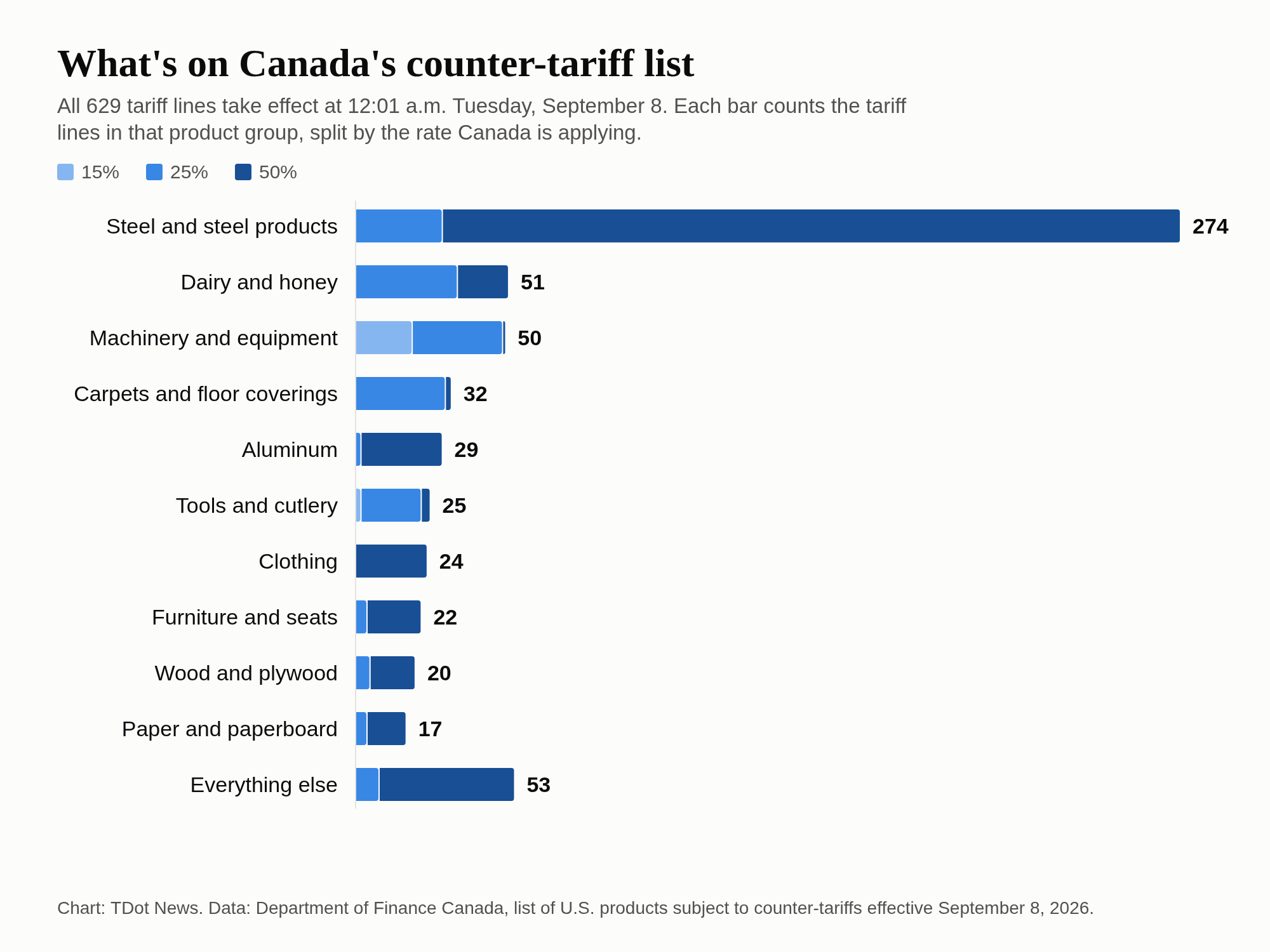
Canada’s counter-tariffs on American goods come into force at 12:01 a.m. on Tuesday, September 8. The product list has been public since August 25, and it runs to 629 tariff lines.
TDot News counted every line. Of the 629, 413 carry the 50 per cent rate, 195 carry 25 per cent and 21 carry 15 per cent — the smallest band, and the one that has gone almost unmentioned.
Metal is close to half the list
Steel and steel products — iron and steel itself, and the articles made from it — account for 274 of the 629 lines, or 44 per cent of the list. Of those, 245 sit at 50 per cent. Add aluminum’s 29 lines and metals alone come to 303 lines.
That is the shape of a countermeasure built to answer the U.S. move it responds to: Washington applied a 50 per cent tariff to $27.6 billion of Canadian goods on August 22, under Section 338 and Section 232 authorities.
What a shopper would recognize
Most of the list is industrial. But the 50 per cent band also reaches goods with a price tag in a store: video game consoles and table or parlour games; equipment for general physical exercise and gymnastics; motorcycles and mopeds; seats and other furniture; perfumes, makeup and hair preparations; clothing; plywood and laminated wood; and glass containers.
The 25 per cent band is where the groceries are. Cheese fills 34 of its lines — fresh cheese, cheddar, brie, mozzarella and the rest. The same rate covers carpets and floor coverings (30 lines), toilet paper and tissues, coniferous sawn lumber, trailers and semi-trailers, and rail locomotives and rolling stock.
The 21 lines at 15 per cent
The lightest rate is reserved almost entirely for capital equipment: dies for drawing or extruding metal, and tools for pressing, stamping or punching; forklifts and other works trucks; cranes and other lifting, handling and loading machinery, with their parts; harvesting and threshing machinery, including combines, with their parts; and moulding boxes and moulds for metal foundries.
Two entries in that group are things a household can buy: window, wall, ceiling and floor air conditioners, and domestic heat pumps. They are the only consumer goods anywhere on the list carrying the lowest rate.
What the list is, and what it is not
A tariff line is not a product. Each line is a tariff item under the Harmonized System, and one line can cover a great many goods — “seats, whether or not convertible into beds” is a single line and most of a furniture aisle. So 629 lines does not mean 629 things.
The tariffs apply to goods that originate in the United States, as defined by the CUSMA country-of-origin marking regulations — not simply to anything shipped from a U.S. address. They do not apply to U.S. goods already in transit to Canada on the day the measures come into force.
The importer of record pays the tariff at the border. Whether that reaches a shelf price, and how quickly, is decided further down the chain.
The currency argument running alongside all of this — the U.S. president’s Sunday post calling Canada’s dollar imbalance “unacceptable” — is covered separately.
Source: Department of Finance Canada, “List of products from the United States subject to counter-tariffs effective September 8, 2026”, August 25, 2026.